Procurement and Logistics Guide
Why Does a Cheaper Toy Quotation Often Cost More?
Why do cheap toy quotations fail importers? Compare BOM, accessories, packaging, and SEA compliance before approving a supplier.
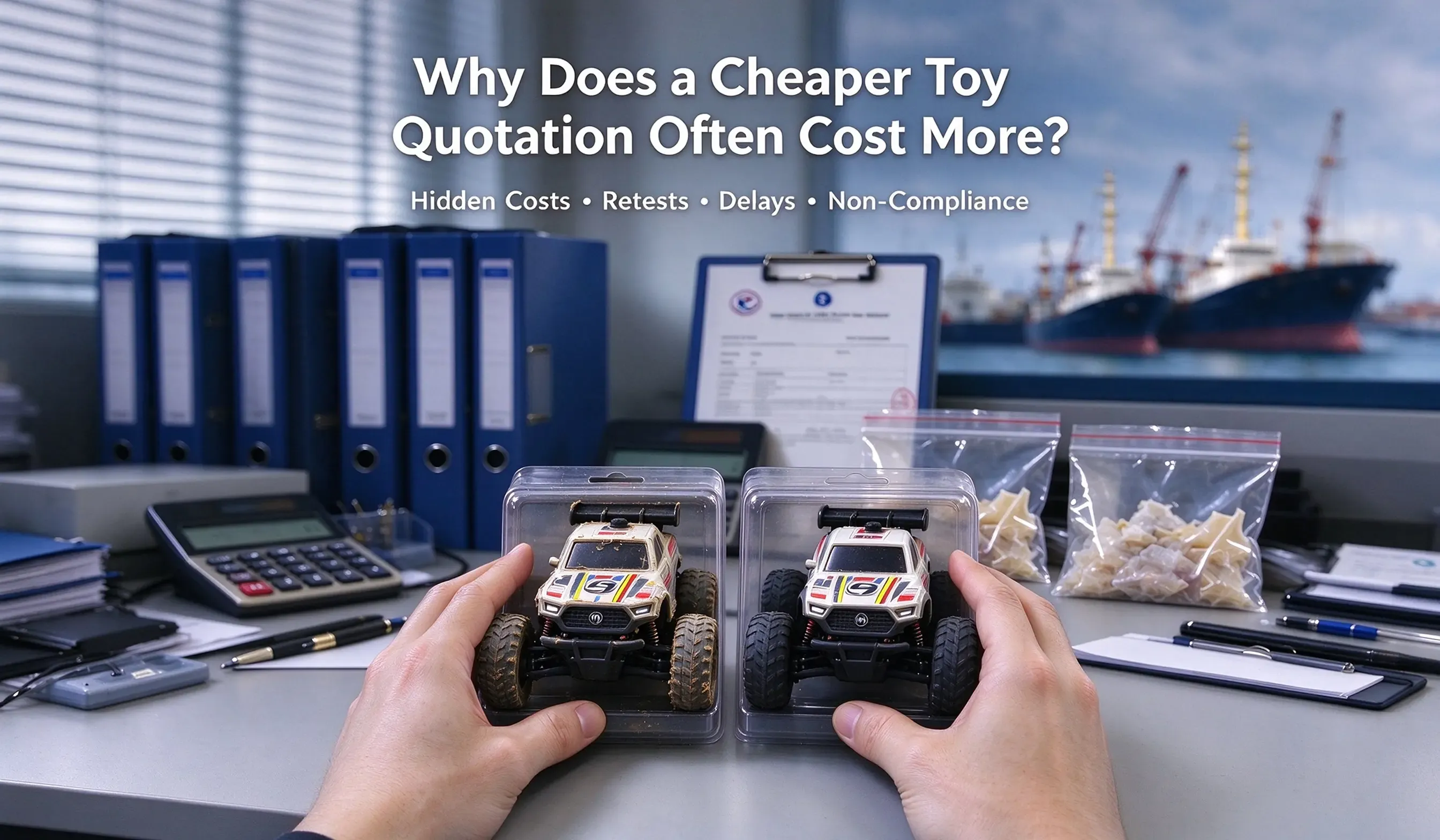
A buyer forwards two quotations for what looks like the same building block set. One is 20% lower. The product photos are nearly identical: same shape, same color, same apparent features. The natural question is why pay more? The harder question is whether both quotations actually cover the same product specification.
For toy importers, wholesalers, and distributors, a lower number deserves attention. But a lower number is not proof of a better deal. A water blaster can ship with a thinner shell. A play set can arrive with fewer accessories. A gift box can use a lighter board grade. None of these show up in a catalog image—yet all of them surface as cost once the goods reach your warehouse, your retailer, or your end customer.
This article gives B2B buyers a practical specification checklist to compare toy quotations on equal terms, before a low price becomes an expensive surprise. See our [INTERNAL LINK: building blocks wholesale category] and [INTERNAL LINK: RC toy wholesale category] for examples of fully specified offers.
1. Materials: When "Same Photo" Hides a Different Specification
A product photo rarely tells you the resin grade, wall thickness, or material formulation behind it. Two similar-looking toys can differ sharply in weight, rigidity, surface finish, and how they perform in use.
Reducing wall thickness around a handle or screw point lowers material consumption. Whether the revised design still performs is a question of construction and testing—not of appearance. A "food-grade silicone" label on a teether does not replace product-specific checks. What matters is the specified material, its consistency, the design, and evidence the finished product meets the agreed performance and applicable safety rules.
Before approving a quotation, ask for:
- The material specification for the main body and critical components.
- Any agreed limits on recycled content or material substitutions.
- Product dimensions, target weight, and acceptable tolerances.
- Functional and durability checks suited to the toy's intended use.
- Relevant testing documentation for the specific product and destination market.
[EXTERNAL: CPSC Toy Safety Business Guidance]
2. Accessories & Packaging: What Does "One Set" Actually Include?
"Water play set" or "gift box packaging" is not a complete specification. One quote may cover only the main toy; another may include a storage bag, spare connector, and instruction leaflet. Both can be legitimate—but they are different purchasing options, and the comparison becomes misleading when those differences stay unclear.
Area to compare | What to put in writing | What to check before shipment |
|---|---|---|
Main product | Model, configuration, quantity per set | Correct version and count |
Accessories | Itemized list, quantities, key specs | Every agreed component present |
Instructions & labels | Approved artwork, language, required warnings | Correct revision applied |
Retail packaging | Board type/weight, dimensions, inserts, printing | Construction matches approved spec |
Export packing | Carton spec, pack quantity, protective arrangement | Actual cartons match the order |
A gift box described only by its dimensions can still vary in construction. Moving from 350 g/m² to 250 g/m² paperboard changes the agreed packaging specification even when the artwork is identical. Board weight alone does not determine strength—board type, thickness, inserts, box structure, and the export carton all matter. Assess the complete packing system against expected handling and transport. A simplified set may suit a price-sensitive channel, but it should be offered as a clearly identified option with a matching sample, never a quiet substitution for what you approved. See [INTERNAL LINK: toy sample approval SOP] for our review process.
3. Compliance & Certification: The Spec That Protects Your Market Access
The specification that protects your business is the one tied to your destination market. A toy compliant for one region is not automatically compliant for another.
- EN71 / CE covers the European market; ASTM F963 / CPSIA covers the United States; ISO 8124 is the broad international baseline many markets reference.
[EXTERNAL: ISO 8124]
- For Southeast Asia, the rules are local and easy to underestimate:
- Indonesia — SNI: mandatory national standard for many toys, with certification and labeling requirements.
[EXTERNAL: Indonesia BSN / SNI]
- Thailand — TISI: mandatory standards and import control for designated toys.
[EXTERNAL: Thailand TISI]
- Philippines — PS (ICC): the Bureau of Product Standards marks scheme for imported toys.
[EXTERNAL: Philippines DTI-BPS]
- Vietnam — QCVN: national technical regulation on toy safety.
[EXTERNAL: Vietnam MOST / QCVN]
A lower quote that omits the certification your market requires is not a saving—it is a customs hold, a recall risk, or a Blocked shipment. Confirm the exact standard, the certificate number, and whether it travels with the goods.
4. Three Steps to Compare Quotations on Equal Terms
Use one shared specification and one approved sample across quotation, ordering, and shipment checks.
Step 1: Build one written specification sheet. Cover materials, configuration, accessories, packaging, and required checks. Align the commercial basis too: order quantity, delivery terms, payment terms, and any separately charged testing or packaging costs.
Step 2: Ask suppliers "what is different from the approved specification?" If a supplier proposes a cost-saving alternative, ask for the change and its price impact separately. Attach the accepted specification and sample reference to the order, and require written approval before any substitution.
Step 3: Hold a dated approved sample and inspect against it before shipment. Keep an identifiable reference sample and ensure the supplier holds the same one. During production and before release, check actual goods against that sample, the component list, and the written specification. Resolve discrepancies before shipment, and keep inspection records with the order so the next repeat purchase starts from a clear baseline.
What a 20% Lower Quote Really Costs You
Consider a hypothetical quotation of 5.00 per set—a 20% reduction, or $1,000 saved across 1,000 sets. The next question is whether both offers include the same specification. If the cheaper option requires extra accessories, repacking, inspection, or replacement of unsellable units, those costs shrink the initial saving.
A useful comparison:
Effective cost per saleable unit = (total procurement + corrective costs) ÷ saleable units.
Use the same cost basis for both offers and avoid counting the same expense twice. Also weigh the costs that are harder to price immediately: missed launch dates, retailer penalties, and reputation damage with your own customers. A lower quote does not automatically become the more expensive choice—but an unexplained specification gap usually does.
How InLuv Toys Keeps Quotations Comparable
At InLuv Toys, we document the agreed materials, accessories, and packaging, and use the confirmed specification and approved sample as the reference for bulk production. Cost-saving changes are discussed openly and approved before implementation—no unapproved material downgrades, omitted accessories, or reduced finishing to preserve a quoted price.
If a different configuration better suits your budget, the difference is visible before you place the order. Comparing toy supplier quotations? Send InLuv Toys your product reference, target market, required accessories, packaging requirements, and expected quantity via [INTERNAL LINK: request a comparable quotation], and we will help you clarify specifications and compare options with confidence. Learn more about our supply approach at [INTERNAL LINK: about InLuv Toys / Shantou supply].
FAQ
Q: How do I know if two toy quotations are for the same product?A: Require both suppliers to quote against one written specification sheet (BOM, packaging, accessories, required checks). Compare the difference items, not just the total price.
Q: What should a toy quotation specification sheet include?
A: Main body material and grade, dimensions/weight/tolerances, itemized accessories with quantities, retail packaging (board grade, structure, inserts), export carton and pack quantity, required testing and certification, plus MOQ, lead time, and payment terms.
Q: Why do cheap toys fail safety compliance in my market?
A: Low prices often come from unstated material downgrades or missing certification. Indonesia SNI, Thailand TISI, Philippines PS, and ISO 8124 must match the destination market—one standard does not cover all.
Q: Does a lower MOQ always mean a better deal?
A: Not necessarily. A low MOQ can carry a higher unit price, a simplified configuration, or weaker quality control. Evaluate by effective cost per saleable unit, not by unit price alone.
Q: How do I verify a supplier's claimed material or certification?
A: Request the product-specific test report and certificate number, retain an approved sample for comparison, and inspect against it before shipment (AQL 2.5), using third-party inspection when needed.
Website: www.inluvtoys.com
Email: henry@inluvtoys.com
Phone / WhatsApp / WeChat: +86-13411918746