Sep 9, 2026Custom Case
How to Source and Launch a Custom Children's Toy Subscription Box from China?
Learn how a European children's brand sourced 5 custom toys, branded packaging, assembly, and fulfillment from China in this step-by-step case study. Includes EN71/CE compliance, MOQ negotiation.
What Is a Children's Toy Subscription Box?
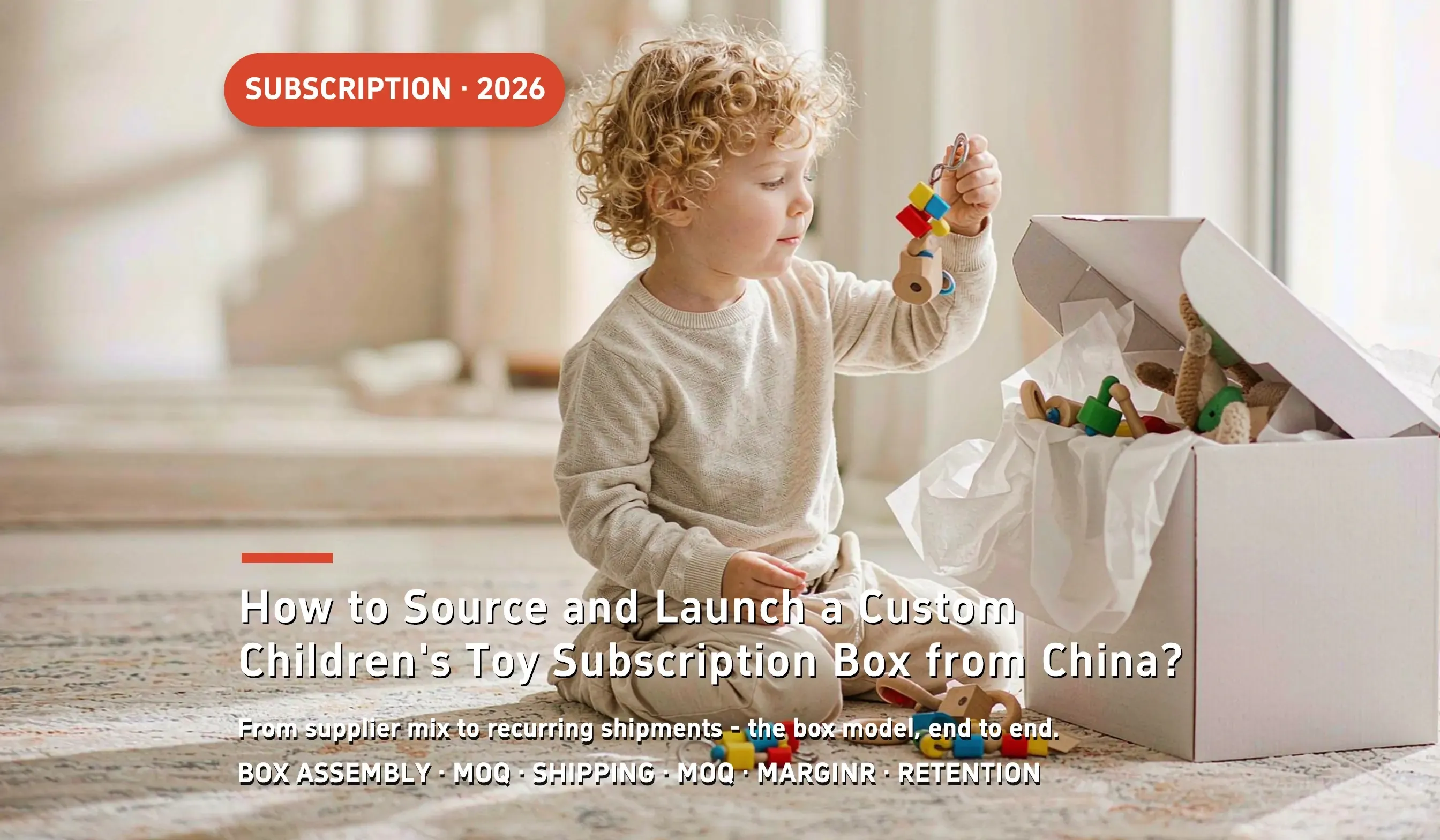
A children's toy subscription box is a curated package of age-appropriate toys, activities, and educational materials delivered to customers on a recurring basis (monthly, quarterly, or seasonally).
Key characteristics:
- Curated theme — each box follows a theme (e.g., "Animal Adventure," "Space Explorer")
- Age-specific — products are selected for a narrow age range (e.g., 2–5 years)
- Mixed activity types — typically combines creative, educational, sensory, and playful items
- Branded unboxing experience — custom packaging, tissue paper, stickers, and activity cards
- High perceived value — customers pay a premium for curation and convenience
For brands, the challenge is sourcing 5–8 different toys at a cost that leaves healthy margins, while ensuring every item meets the safety standards of the target market.
Why Source Children's Toys from China?
China accounts for over 70% of global toy production, concentrated in regions like Chenghai (Shantou), Yiwu, and Dongguan. Here's why toy brands continue to source from China:
Advantage | Details |
|---|---|
Unmatched product range | Hundreds of thousands of SKUs across every toy category |
Cost efficiency | 30–60% lower unit costs compared to European or American manufacturing |
Customization capability | OEM/ODM for packaging, colors, logos, and product modifications |
Integrated supply chain | Sourcing, assembly, packaging, and logistics under one roof |
Safety certification expertise | Most factories are familiar with EN71, CE, ASTM, and CPSIA requirements |
The catch: Small test orders (50–100 boxes) often face higher per-unit costs because factories have minimum order quantities (MOQs) ranging from 100 to 1,000+ units per product. Working with a sourcing partner who can mix products across factories is essential for small-batch launches.
Step 1: Qualify the Inquiry — Is This a Real Customer?
Before investing time in a detailed proposal, qualify the lead. In this case study, the initial inquiry contained:
- No company name or website
- A personal email address (not a company domain)
- A name and country only
- A detailed, specific request for 5 toys, custom packaging, assembly, dropshipping, and safety documentation
How to Assess a Lead Without Public Information
Red flags that don't necessarily mean "fake":
- Personal email addresses — many DTC founders operate solo before incorporating
- No website — pre-launch brands often have no online presence
- Small initial order — every big brand starts with a test
Green flags that signal a serious buyer:
- Specific product requirements and age ranges
- Clear service expectations (packaging, assembly, fulfillment)
- Questions about safety compliance and documentation
- Mention of long-term partnership or repeat orders
In this case: The inquiry was highly specific and professional — a clear sign of a serious founder, not a tire-kicker.
Step 2: First Reply — Don't Quote, Ask Questions First
The biggest mistake new suppliers make is quoting immediately. Without knowing the customer's budget, order volume, brand positioning, and timeline, any quote is a guess.
What to Include in Your First Reply
1. Confirm capability — State clearly that you can handle sourcing, custom packaging, assembly, and fulfillment.
2. Send a product catalog — Give the customer a sense of your product range and quality level.
3. Ask 5 strategic questions — Frame each as "to build the best proposal for you":
- Brand background — What's your brand name and positioning? (Also helps verify identity)
- Box theme and target age — What theme and age range are you targeting?
- Order volume and frequency — What's your test order quantity and expected monthly volume?
- Target retail price and budget — What's your target cost per box? (Determines product tier)
- Logistics and compliance preferences — Do you prefer bulk shipping to your warehouse or individual dropshipping? What certifications do you need?
Why This Works
The customer in this case study replied with a detailed 400+ word email covering every question, plus:
- Brand name and first collection theme
- Exact age range (adjusted from 3–6 to 2–5 years)
- Desired product mix (fun, creativity, learning, fine motor)
- Test order of 50–100 boxes with scaling potential
- Interest in a long-term sourcing and fulfillment partnership
Key takeaway: Asking good questions signals professionalism and gives you the information needed to build a proposal that actually fits.
Step 3: Recommend the Right Product Mix
The customer initially selected 5 products from the catalog but also asked for recommendations. Rather than offering 4 different plans (which created decision paralysis), we built one custom recommendation with clear reasoning.
Selection Criteria for a 2–5 Year Old Animal-Themed Box
Criterion | Why It Matters |
|---|---|
Strong animal theme | Every product should tie into the "Animal Adventure" concept |
No batteries | Customer requirement; also reduces safety hazards and shipping weight |
Age-appropriate (2–5) | No small parts that pose choking hazards for under-3s; simple mechanisms |
Mixed activity types | Creative + educational + sensory + playful = balanced box |
Perceived value | At least 1–2 "hero" items that make parents feel the box is worth the price |
Weight under 1kg total | Keeps domestic shipping costs low in the target market |
Compact dimensions | All items must fit inside a box |
The Recommended 5-Product Mix
1. Animal Finger Puppets
- Role-play and storytelling; different animals
- Serves as the "hero" item with high perceived value
- Soft fabric, no small parts
2. Animal Water Painting Book
- Creative activity; reusable water pen, no mess
- Educational: animal recognition, colors, fine motor control
- Compact and lightweight
3. 3D Animal Stereoscopic Puzzle
- Spatial reasoning and problem-solving
- EPS foam material — safe, soft, no sharp edges
- Flat packaging saves space; assembled product creates "wow" factor
4. Press Animal Inertial Car
- Cause-and-effect learning; press and release to move
- No batteries required
- Develops fine motor skills and hand-eye coordination
5. Pull-String Canned Animal Toy
- Surprise element: pull the string and the animal moves/wobbles
- Adds playful, interactive dimension
- Compact can-shaped packaging
Why This Combination Works
- 4 of 5 products feature actual animal shapes — the theme is undeniable
- Activity balance: creative (water book) + educational (puzzle) + sensory (puppets) + playful (car + canned toy)
- No batteries across the entire box
- Total Lightweight — under the 1kg threshold for low-cost domestic shipping
- Price structure: 2 premium items (puppets + water book) carry perceived value; 3 economical items keep total cost manageable
Step 4: Handle the Tough Questions
After reviewing the proposal, the customer asked five detailed questions before committing to a sample. These are the questions that separate casual inquiries from real buyers.
Question 1: Will All 5 Products Fit in the Box?
The customer noticed that one product's listed height, exceeded the box's stated height.
Answer: Confirm the box orientation. The box dimensions are x cm, but the x cm side functions as the height when the box is placed in its intended orientation. The x cm product fits comfortably. Always verify actual product dimensions and provide a clear packing layout or photo.
Question 2: What's the Detailed Price Breakdown?
The customer calculated their own total and asked what the remaining cost covered.
Answer: Provide a transparent line-item breakdown
Transparency builds trust. Customers will do their own math — hiding fees or bundling costs without explanation creates suspicion.
Question 3: What's the Actual MOQ for a Mixed Order?
The customer was concerned about factory MOQs of 500–800 units per product.
Answer: For a mixed kitting order, the effective MOQ is the box quantity, not the per-product factory MOQ. In this case, x boxes = x units of each product. The higher per-unit cost for small quantities already reflects the MOQ premium. This is a critical advantage of working with a sourcing partner who can aggregate orders across multiple factories.
Question 4: Can We See Real Product Photos Before Ordering Samples?
Answer: Yes, but it requires sourcing physical samples from each factory. This takes 3–5 business days and may involve sample procurement costs. Offer to send photos and a short video once samples are in hand.
Question 5: Can You Provide EN71 Test Reports and CE Declarations Before Ordering?
This is the most sensitive question. Most Chinese toy factories will not release full EN71 test reports or CE Declarations of Conformity (DoC) before an order is confirmed, because these documents contain factory-specific information.How to handle it without losing the customer:
- Explain the policy honestly — "Factories protect their test reports as proprietary documents; full reports are released after order confirmation."
- Provide a format sample — Send a redacted example of an EN71 report and a CE DoC template so the customer sees exactly what they'll receive.
- Provide labeling references — Share official EU toy labeling examples (e.g., from Tukes Finland) showing CE marking, manufacturer info, batch numbers, age warnings, and safety instructions.
- Commit in writing — Confirm that full documentation will be provided with the bulk order.
The customer accepted this approach. The key was offering a concrete alternative (format samples + labeling references) instead of a flat "no."
Step 5: Move to Sample Order
Once the customer confirmed the product mix, pricing, and documentation approach, the final steps before the sample order are:
1. Collect Brand Assets
Request the customer's logo file in vector format (AI/EPS) or high-resolution PNG with transparent background. This is needed for:
- Packaging mockup design
- Custom logo sticker production
- Box printing (if fully custom)
2. Create a Packaging Mockup
Design a visual mockup showing:
- The custom box with logo placement
- The logo sticker design and placement
- Any additional branding elements (tissue paper, activity cards)
Timeline: 1–2 business days after receiving the logo.
3. Customer Approves Mockup
The customer reviews and approves the mockup before any production begins. This prevents costly rework.
4. Sample Production and Shipping
- Production time: 5–7 business days
- Shipping to Europe: 7–12 business days via air express (e.g., DHL, FedEx)
- Sample fee refund: Often refundable or deductible from the first bulk order
5. Sample Review and Bulk Order
The customer evaluates:
- Product quality and safety
- Packaging print quality
- Overall unboxing experience
- Accuracy of the product mix
If approved, proceed to the bulk order.
What Safety Documentation Do You Need for Toys Sold in Europe?
For toys sold in the EU and Switzerland (which aligns closely with EU toy safety regulations), the required documentation includes:
EN71 Test Report
EN71 is the European standard for toy safety, consisting of:
- EN71-1: Physical and mechanical properties
- EN71-2: Flammability
- EN71-3: Migration of certain elements (heavy metals)
A third-party laboratory (e.g., SGS, Bureau Veritas, Intertek) issues the test report.
CE Declaration of Conformity (DoC)
A legal document issued by the manufacturer or its authorized representative, declaring that the product complies with the EU Toy Safety Directive (2009/48/EC). The DoC must include:
- Manufacturer name and address
- Product identification (model, batch, serial number)
- Reference to the toy safety directive
- Reference to harmonized standards (EN71 series)
- Notified body information (if applicable)
- Signature and date
Product Labeling Requirements
Every toy or its packaging must display:
Element | Requirement |
|---|---|
CE marking | Visible, legible, indelible; minimum 5mm height |
Manufacturer name & address | Full legal name and registered address |
Product identifier | Model number, batch number, or serial number (for traceability/recalls) |
Age grading | Recommended age range (e.g., "Ages 2–5") |
Age warnings | "Warning: Not suitable for children under 36 months" + 0-3 pictogram, if small parts present |
Safety instructions | Usage instructions, warnings, and care instructions as applicable |
Country of origin | "Made in China" |
EU responsible person | Name and address of EU-based responsible person (for manufacturers outside the EU) |
FAQ
What is the minimum order quantity for a custom toy subscription box from China?
For a mixed kitting order (multiple different products in one box), the practical minimum is typically 100 boxes. This means 100 units of each product, not the per-product factory MOQ (which can be 300–1,000+ units). The per-unit cost is higher at 100 units due to small-batch premiums, but it allows brands to test the market before committing to large volumes.
What certifications do I need to sell toys in Europe?
Toys sold in the EU and Switzerland require:
- EN71 test report (parts 1, 2, and 3) from an accredited laboratory
- CE Declaration of Conformity (DoC) issued by the manufacturer
- CE marking on the product or packaging
- Correct product labeling (manufacturer info, batch number, age warnings, safety instructions)
Can I source more different toys from more different factories in one box?
Yes, this is standard practice for subscription boxes. A sourcing partner or trading company can:
- Source each product from its specialized factory
- Consolidate all products at one location
- Perform quality inspection on each item
- Assemble (kit) the complete box
- Apply custom packaging and labeling
- Ship the finished boxes
This "kitting" model allows access to the best factory for each product type while maintaining a single point of contact.
How long does it take to produce and ship a custom toy box from China?
Typical timeline for a 50–100 box test order:
- Sample procurement & photos: 3–5 days
- Packaging mockup design: 1–2 days (after logo received)
- Sample production: 5–7 days (after mockup approval)
- Sample shipping to Europe: 5–10 days (air express)
- Bulk production: 15–25 days (after sample approval)
- Bulk shipping to Europe: 5–10 days (air) or 25–35 days (sea)
Total from inquiry to customer receiving bulk order: approximately 6–8 weeks.
Should I ship individual orders from China or bulk to my warehouse?
For European markets, bulk shipping to your warehouse is strongly recommended for the following reasons:
- Cost: Individual air express shipments from China to Europe cost $20–$40 per parcel. Bulk sea or air freight reduces per-unit shipping to $2–$5.
- Customs: Each individual shipment may trigger customs clearance, duties, and delays. A single bulk shipment clears customs once.
- Customer experience: Domestic shipping within Europe takes 1–3 days vs. 7–15 days from China. Customers expect fast delivery.
- Returns: Handling returns domestically is far easier than international reverse logistics.
For a test order, air or sea freight to the customer's warehouse is the most cost-effective and reliable option.
Final Thoughts
Sourcing a custom children's toy subscription box from China is a multi-step process that requires product expertise, negotiation skill, and careful compliance management. The brands that succeed are those who:
- Invest time in qualifying suppliers and products
- Build transparent pricing structures
- Prioritize safety documentation and labeling compliance
- Start small with test orders before scaling
- Partner with sourcing experts who can navigate the complex Chinese toy supply chain
-
The European children's toy market continues to grow, and subscription boxes offer a unique opportunity for brands to build recurring revenue and customer loyalty. With the right sourcing partner, the process is far more accessible than most founders expect.
Ready to source your own custom toy subscription box?
Get in touch with our team for a free product consultation and custom proposal. We specialize in educational toys, custom packaging, and end-to-end fulfillment for European and North American brands.
Website: www.inluvtoys.com
Email: henry@inluvtoys.com
Phone / WhatsApp / WeChat: +86-13411918746