Procurement and Logistics Guide
How to Choose STEM Toys: 5 Mistakes B2B Buyers Make
What goes wrong when buyers choose STEM toys? Age mismatch, empty "STEM" claims, safety oversights, and low replay—explained for importers.
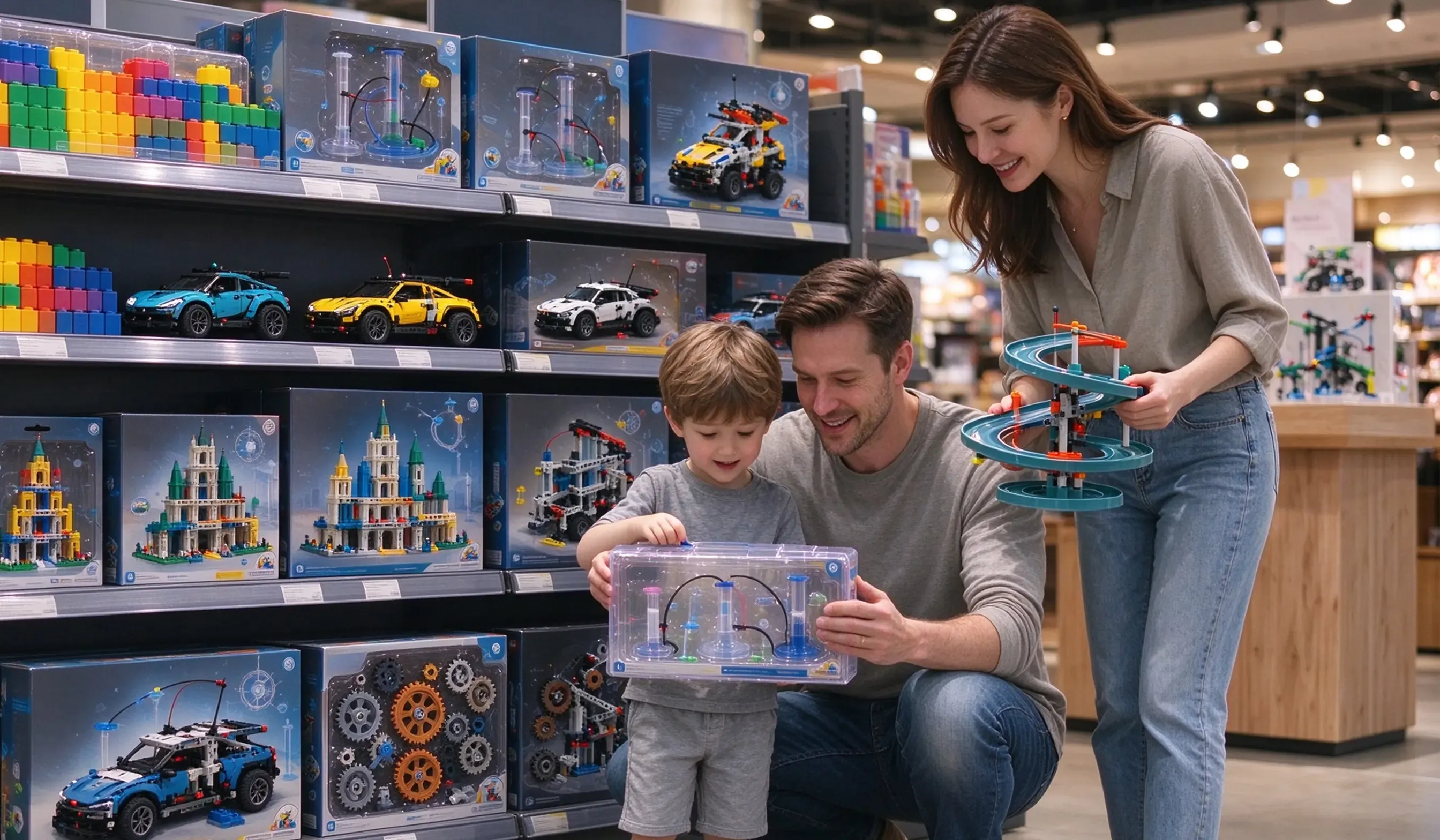
Common Mistakes When Buying STEM Toys to Avoid
Buying a STEM toy based only on its appearance or the word "STEM" can lead to a poor product choice. The toy may be too difficult for its intended age group, offer limited learning activities, or hide a safety gap that only shows up after the goods reach your warehouse or your customer.
For B2B buyers selecting STEM toys for resale, evaluating the actual play experience and the underlying compliance is more useful than relying on marketing claims. As a Shantou-based toy supplier, InLuv Toys works with STEM building-block and RC lines every day—here are the most common mistakes we see buyers make, and how to avoid them.
Mistake 1: Ignoring Age, Skill Level, and Grade Appropriateness
Age recommendations provide a useful starting point, but they do not tell the whole story. A toy may be suitable for a particular age range while still requiring reading, assembly, programming, or problem-solving skills some users do not have.
When evaluating STEM toys, consider both the stated age and the actual difficulty of the activity. A beginner building kit, for example, should not require advanced technical knowledge simply because it is marketed as educational. For B2B buyers, the target age should also match the customer segment and retail positioning—preschool, primary school, or tween.
Mistake 2: Buying the "STEM" Label Instead of the Actual Activity
Not every product marketed as a STEM toy provides the same type of learning activity. Look at what the user actually does with the product:
- Build and assemble components
- Test different configurations
- Measure or observe results
- Solve problems
- Program or control a device
- Experiment with different solutions
The real question is not whether a product is called an educational STEM toy, but whether its core activity gives the user meaningful opportunities to explore STEM concepts. A building-block set that only replicates one fixed model is a different product from one that supports free construction.
Mistake 3: Overlooking Safety and Compliance (the Costly One)
This is where a "cheap" purchase becomes expensive. Safety should be evaluated against the actual product and its target market, not its general category. Depending on the design, relevant hazards include small parts (choking risk for under-3s), high-powered magnets (ASTM F963-22 tightened magnet requirements after documented injuries), button or lithium batteries (ingestion risk), and electrical components.
[EXTERNAL: CPSC] [EXTERNAL: ASTM F963]
The standard that applies depends on where you sell:
- EN71 for the European market
- ASTM F963 for the United States
- ISO 8124 as the broad international baseline many markets reference
- SNI (based on ISO 8124) for Indonesia, where toys for under-14s require certification before import
[EXTERNAL: ISO 8124][EXTERNAL: BSN]
Do not assume one set of requirements covers every STEM toy. Confirm the applicable standard and the test reports for the specific product and destination before you buy.
Mistake 4: Choosing a Toy That Is Too Prescriptive
A STEM toy can provide instructions without being overly restrictive. The problem occurs when the user has almost no opportunity to make decisions, test alternatives, or change the result.
For example, a building or coding toy can offer a guided starting activity while still allowing users to create different configurations or solutions. When comparing open-ended STEM toys, consider how much freedom the product gives users to experiment. The right level of guidance depends on the intended age and learning objective—too little structure frustrates beginners; too much bores older kids.
Mistake 5: Overlooking Usability, Setup, and Replay Value
A STEM toy may contain many components but still deliver limited value if it is hard to set up or becomes repetitive after one use. Before buying, consider:
- How much assembly or setup is required
- Whether batteries, apps, or other devices are needed
- Whether instructions are clear
- Whether the toy supports different activities or configurations
- Whether users can keep experimenting after the initial activity
For buyers, STEM toy replay value matters because a product that supports repeated or varied play tends to generate fewer returns and stronger word-of-mouth than a one-time activity.
How to Evaluate a STEM Toy Before Buying
A practical STEM toys buying guide reduces to a few key questions:
Factor | What to evaluate | Why it matters |
|---|---|---|
Intended user | Age, skills, prior experience | Prevents age mismatch and returns |
Activity | What the user actually does | Separates real STEM from label hype |
STEM element | Building, testing, coding, measuring, problem-solving | Confirms educational claim |
Difficulty | Whether the challenge fits the user | Drives satisfaction, not frustration |
Safety | Product-specific hazards + market standard (EN71/ASTM/ISO/SNI) | Avoids recalls, customs holds, injuries |
Usability | Setup, instructions, batteries, apps, consumables | Affects first-use experience |
Replay value | Opportunities for repeated or modified play | Protects your brand with end customers |
The goal is not to find a toy with the most features. It is to find a product whose difficulty, activity, safety, usability, and play potential match its intended users and market.
Conclusion
Choosing the right STEM toy requires looking beyond the STEM label. Buyers should weigh age and skill level, actual learning activities, safety and compliance, usability, and replay value together.
For B2B buyers, this evaluation also determines whether a product fits its intended customer segment and market—including the certification required for that market (SNI for Indonesia, for example). A STEM toy with the right balance of challenge, safety, and repeat-play potential is more likely to deliver value beyond the first purchase.
Planning a STEM line or comparing supplier quotations? Send InLuv Toys your product reference, target market, and expected quantity via [request a comparable quotation], and we will help you clarify specifications, confirm applicable standards, and plan a compliant order. See our [STEM building blocks wholesale category] and [RC toy wholesale category], or learn more at [about InLuv Toys / Shantou supply].
FAQ
Q: What should I look for when buying a STEM toy?
A: Start with the intended age and skill level, then evaluate the actual STEM activity, difficulty, safety and applicable standard (EN71/ASTM/ISO/SNI), usability, and opportunities for repeated play.
Q: Are STEM toys safe for all ages?
A: No. STEM toys vary in complexity and hazard. Watch for small parts (under-3 choking risk), high-powered magnets, and button or lithium batteries, and confirm the standard required for your market.
Q: Does a "STEM" label guarantee educational value?
A: Not necessarily. Evaluate the actual activity—does the product let users build, test, experiment, solve problems, or explore concepts—rather than trusting the label.
Q: Which safety standard applies to my market?
A: EN71 for Europe, ASTM F963 for the United States, ISO 8124 as the international baseline, and SNI (based on ISO 8124) for Indonesia. Confirm the specific requirement for your destination before import.
Q: What makes a STEM toy worth repeat play?
A: Varied activities, multiple configurations, experimentation, and the ability to modify or build on previous results give a STEM toy greater replay potential and stronger customer retention.
Website: www.inluvtoys.com
Email: henry@inluvtoys.com
Phone / WhatsApp / WeChat: +86-13411918746