Sep 23, 2026Procurement and Logistics Guide
actory vs. Trading Company: Which Is Better for Sourcing Toys From China?
Factory vs trading company for sourcing educational toys from China? Break the “factory = cheapest” myth, calculate total landed cost, cut hidden fees & pick the right supplier.
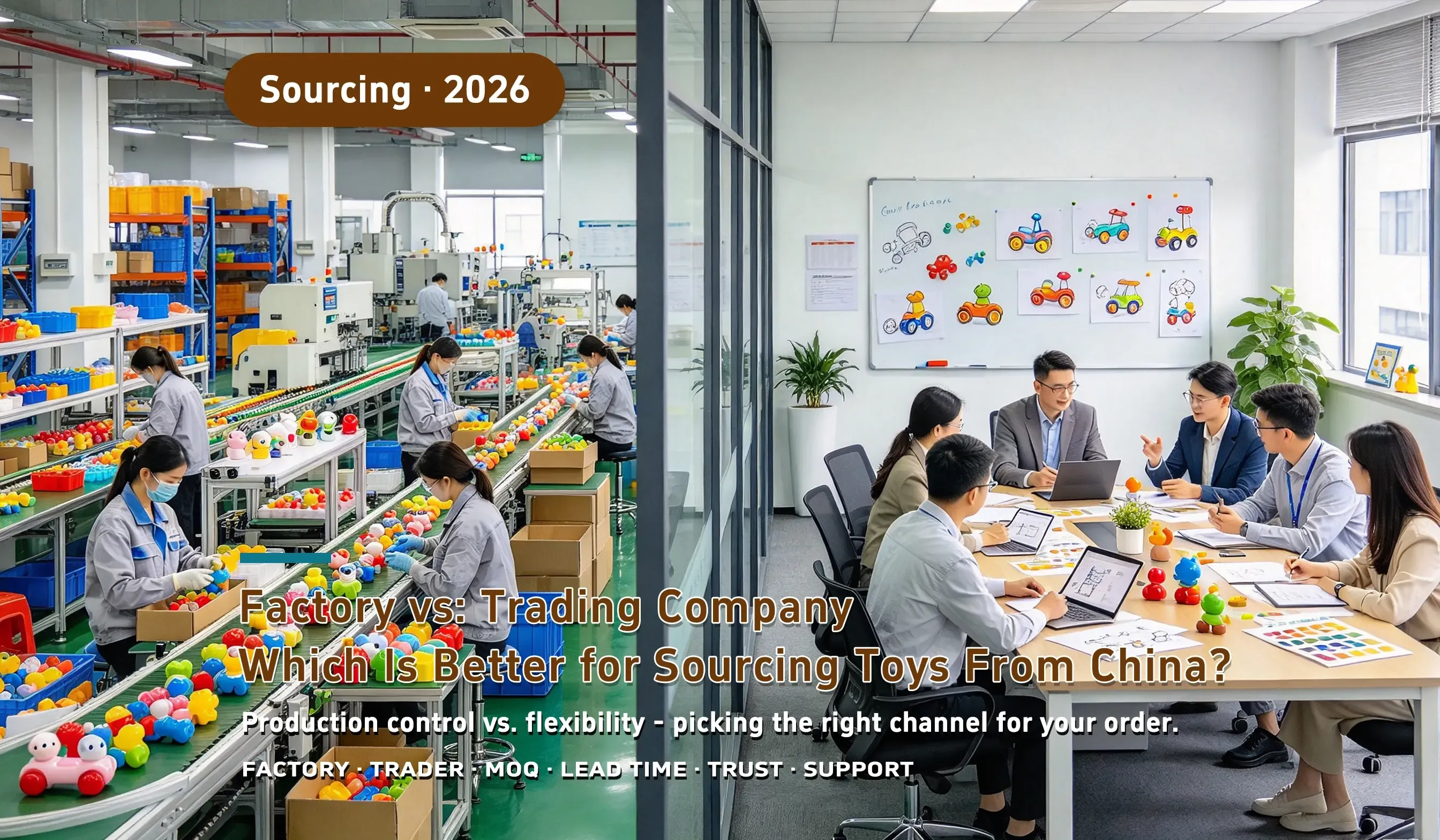
If you’re importing educational toys from China, there’s one question you’ve almost certainly led with: can I go direct to the factory for the lowest price?
It’s the most logical first move for any buyer. Cut out the middleman, skip the trading company markup, and lock in the best ex-factory unit cost. For most procurement teams, lower unit price = better deal — end of story.
After 12+ years sourcing STEM toys, puzzles and building blocks for EU and US buyers, I get it. Price matters. But the “factory = cheapest” narrative is a dangerous half-truth. More often than not, chasing the lowest factory unit price ends up raising your total landed cost, and your risk.Let’s do the real math.
The “Factory = Lowest Price” Myth: 3 Reasons Your Unit Price Is Lying To You
Let’s start with the one case where factories absolutely are cheaper: if you’re placing a large, single-SKU order that meets their full MOQ, and you handle all logistics, QC and troubleshooting yourself. A 2025 China CCPIT report confirms factory pricing is 8%–25% lower than trading companies for identical high-volume products. That gap is real.
But that scenario is rare for most educational toy buyers. Here’s why the “lowest factory price” almost never translates to the lowest total cost:
1. Factory “floor prices” come with hidden strings you can’t meet
That rock-bottom unit price you see quoted? It’s almost always tied to a high MOQ, standard designs only, no custom modifications, no export documentation support, and zero after-sales accountability.
If you need a 500-piece trial order, custom logo printing, or help with CE/ATC paperwork, that “low price” vanishes immediately. For small to mid-sized orders, many factories quote a “discouragement price” higher than what established trading companies charge — because small orders aren’t worth their production line setup time.
Trading companies place aggregated volume across multiple clients, so they lock in true factory bulk pricing that individual small buyers can never access on their own.
2. You’re only comparing unit price — not total landed cost
This is the biggest mistake buyers make. You fixate on the per-piece ex-factory price, but ignore all the hidden costs that add up along the way:
- Multiple factory communication and negotiation hours
- Separate QC inspection fees for each factory
- Multiple LCL shipments instead of one consolidated container
- Separate export documentation fees per supplier
- Rework, replacement or scrap costs for quality issues
For example: say you’re sourcing 4 different educational toy lines (puzzles, building blocks, STEM kits, sensory toys), 500 pieces each.
- Direct factory pricing: ~10% lower per-unit on paper
- But you pay 4 inspection fees, 4 separate LCL shipments, and 4 sets of export docs
- Per Freightos data, multiple small LCL shipments cost 20%–35% more than one consolidated full container
Add in the labor hours of managing 4 supplier relationships, and your total cost ends up 12%–18% higher than working with one trading company that consolidates everything. The unit price was cheaper. The total bill was not.
3. Trading companies don’t “mark up the same product” — they eliminate costs you’d pay anyway
A common misconception: trading companies buy from factories, add 10%–15%, and sell you the exact same thing.
That’s not how it works. The fee you pay a trading company replaces costs you would incur on your own: supplier vetting, production monitoring, quality inspection, cargo consolidation, export compliance and issue resolution.
You’re not paying extra for the same product. You’re paying a single fee to replace 5+ separate costs and 10+ hours of your team’s time. For most buyers under 10,000 pieces per SKU, that bundled cost is lower than doing it all yourself.
How to Actually Decide: Match Your Supplier to Your Order Structure
There’s no universal “better” option. The right choice depends entirely on your order size, SKU count, and in-house sourcing capabilities.
When Direct Factory Sourcing Saves You The Most Money
Go straight to a toy manufacturer if all of these apply:
- High volume, 1–2 core SKUs: 10,000+ pieces per product, enough to hit true factory bulk pricing
- Heavy OEM/engineering changes: Custom molds, functional modifications or proprietary designs — direct communication cuts rework rates to under 17% by eliminating information distortion
- You have on-the-ground support: Your own QC team in China, or you require formal BSCI/ICTI/Sedex audits for retail chain compliance
When A Trading Company Delivers A Lower Total Cost
Work with a trading company if any of these describe your order:
- Multi-category, small per-SKU quantities: 500–2,000 pieces per product, 3+ different toy lines. Consolidation saves more in freight and admin than the service fee
- No local China team: You don’t have staff to vet factories, monitor production or resolve issues remotely
- Trial orders or test runs: First-time small-batch orders where you don’t want to commit to full factory MOQs
What Trading Companies Actually Earn Their Fee For
Beyond pure cost savings, trading companies deliver three things factories almost never do:
- Single-point accountability for multi-product ordersOne quote, one quality check, one shipment, one point of contact. You deal with one partner instead of five or ten.
- Pre-vetted supplier networkThey already filter out unreliable factories, know which plants deliver consistent quality, hit deadlines, and can handle rush orders. You avoid the 40% fraud and quality failure rate that hits first-time small importers (per 2025 HKTDC data).
- Problem-first resolutionFactories are built for manufacturing, not customer service. When a quality issue pops up, a factory’s first move is to explain the technical reason. A trading company’s first move is to fix the problem — because their biggest asset is their customer reputation.
One Canadian toy buyer I work with put it best: “With a factory, you argue about who’s at fault. With a good trading company, you make one phone call and it’s handled. The premium pays for that one phone call.”
The #1 Rule That Beats Every Price Comparison
At the end of the day, there’s one rule that trumps unit price, business type and every sales pitch:
Don’t chase the lowest ex-factory price. Chase the lowest total landed cost with someone who takes responsibility when things go wrong.Don’t ask if they’re a factory. Don’t ask if they’re a trading company. Ask:
- What’s my all-in cost to get this to my warehouse?
- Who covers the cost if there’s a defect in bulk production?
- Who handles rework or replacement if something goes wrong?
A factory that gives you a 5% cheaper unit price but refuses to own quality issues will cost you far more than a trading company that charges 5% more but fixes problems overnight.
One Industry Reality Most Buyers Don’t Know
Let’s clear up one common point of confusion: it’s extremely standard for Chinese toy factories to set up a separate trading entity to handle foreign orders and export tax rebates.
You might sign a contract with a trading company, but the goods are still made on the same factory line by the same production team. This is normal industry practice, not a scam. If you tour the facility and see the production running, you’re working with the real manufacturer — the trading entity is just the export-facing business layer.
Also, most experienced toy buyers don’t pick one or the other — they use a hybrid model. Core high-volume products go straight to the factory for the best pricing. Low-volume SKUs, trial items and accessory products go through a trading company for efficiency. This approach will only become more common through 2026.
You don’t have to lock into one model forever. Pick the setup that gives you the best balance of cost, speed and risk for each order.
Ready to Source Reliable Educational Toys From China?
If you’re looking for a direct manufacturer specializing in STEM and educational toys for EU and US markets, we’re here to help. With 10+ years of export experience, full EN71 & ASTM F963 compliance, and end-to-end quality accountability, we take ownership of every order we produce.
Website: www.inluvtoys.com
Email: henry@inluvtoys.com
Phone / WhatsApp / WeChat: +86-13411918746