Product Knowledge
2.4GHz RC Toy Range, Interference & Signal Stability
Understand what really decides 2.4GHz RC toy range and signal stability, how interference happens, and how B2B buyers should test and specify RC performance.
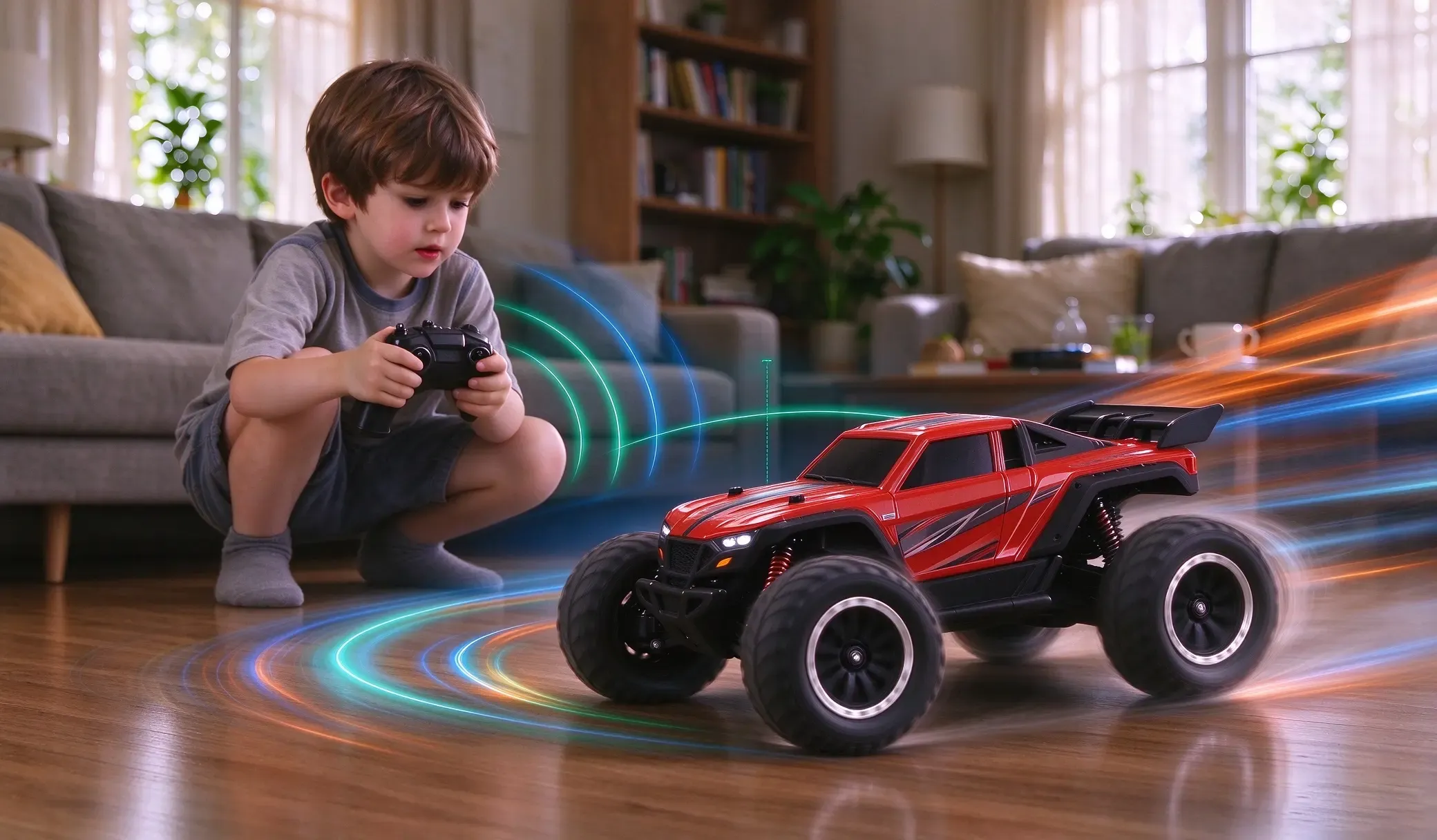
The radio system decides how reliably an RC toy answers its controller. Modern 2.4GHz RC toys support multi-device operation and responsive wireless control—but the frequency band alone does not set the range, nor does it guarantee immunity from interference. As an RC toy supplier, we see the same pattern repeatedly: two products can both say "2.4GHz" and still deliver very different real-world performance. For a B2B buyer, understanding why is the difference between a specification that sells and a shipment that gets complained about.
How 2.4 GHz Actually Affects RC Toy Communication
Frequency Is Only One Part of the SystemIn a basic RC system, the controller transmits commands, the receiver inside the toy detects them, and the control system turns them into steering, acceleration, or stopping. The "2.4 GHz" label describes the radio band—not the maximum range, receiver sensitivity, antenna design, or overall signal stability. Two products on the same band can perform differently because their radio hardware and system design differ.
Why 2.4 GHz Lets Multiple Toys Run TogetherA key advantage of 2.4 GHz is that several toys can operate in one area without manually assigning fixed frequencies. Modern pairing and frequency-management let a specific controller stay linked to its own receiver—so several properly designed RC cars can race without one controller hijacking another toy. But this is pairing, not interference immunity. It keeps the right transmitter talking to the right toy; it does not erase every source of radio-frequency noise.
Can Multiple 2.4GHz RC Toys Interfere With Each Other?
Pairing Prevents Cross-Control—but Not All InterferenceWhen multiple toys are powered on, the system must tell the controller–receiver pairs apart. Good pairing prevents a controller from responding to every nearby receiver—far better than old crystal-based fixed-frequency sets, where two devices on the same channel collided directly. So cross-control is not the expected behavior of a working system.
The Real Risk: A Crowded RF EnvironmentCross-control and interference are different problems. A controller may stay paired while the link gets flaky—showing as delayed response, intermittent control, reduced usable range, or temporary dropout. The 2.4 GHz band is also shared with Wi-Fi, Bluetooth, and other wireless tech, so RC toys live inside a busy radio neighborhood, not an empty frequency.
Why Radio Design—Not the Band—Decides ComplianceInterference can also come from the RC product itself: transmitter behavior, receiver characteristics, antenna design, and control of unwanted emissions. This is not theoretical. In a 2026 EU-funded market-surveillance campaign (JACOP 2025, PSA 5 Radio Toys, run by the European Commission's DG GROW), 88 radio-controlled toys for ages 3–14 were tested; 53 (60%) failed the applicable signal-interference standards, including 36 of 50 RC vehicles. The main causes were spurious emissions and excessive radiated power. The lesson for buyers: "2.4GHz" is not evidence of good interference performance—the full radio implementation and the applicable compliance rules still matter. [https://single-market-economy.ec.europa.eu/news/radio-controlled-toys-tested-signal-interference-2026-06-18_sl]
What Determines RC Toy Range and Stability?
Transmitter, Receiver, Antenna, and ProtocolRange depends on the whole link, not the frequency. Relevant factors: transmitter output, receiver sensitivity, antenna design and placement, radio protocol/architecture, power-supply condition, and the physical environment. A better-designed system keeps a usable link where a weaker one goes unstable—so two 2.4GHz RC toys should not be assumed to have equal range.
Maximum Range vs Stable Usable RangeAs distance grows, the received signal weakens until the receiver can no longer hold reliable communication. That creates a critical distinction: maximum range (the toy may still twitch at the edge) versus stable usable range (where it responds predictably with margin against obstacles and local noise). A range claim should be read in the environment it was measured in—not as a universal number.
Obstacles and Orientation (Line-of-Sight)Physical obstacles attenuate 2.4 GHz, especially when they block a clear path. Walls, furniture, vehicles, and even people alter propagation. A toy that runs cleanly across an open area can weaken once it goes behind a wall or large object.
Why Indoor and Outdoor RC Performance Differs
Environment | Main factors affecting communication |
|---|---|
Open outdoor space | Fewer obstacles, clearer signal path |
Indoor room | Walls, furniture, people, reflections |
Dense indoor | More obstacles + more wireless devices |
Large outdoor area | Distance becomes the limiting factor |
Crowded venue | More wireless devices, competing RF activity |
Indoor: Obstacles and Wireless Congestion. A toy circling a room repeatedly passes behind furniture and walls, cutting signal margin—especially near its practical range limit. Indoor spaces also hold many co-band devices. That said, "Wi-Fi is present" does not automatically mean malfunction; the effect depends on how the radio systems coexist.
Outdoor: Distance and Line of Sight. Open space gives a clearer path, making control more predictable—but users drive farther, so signal strength eventually caps the usable range. An open field is not unlimited range; it just removes some indoor obstacles.
How to Read Common RC Signal Problems
Symptom | Possible factors |
|---|---|
Responsive nearby, unstable farther away | Distance, receiver sensitivity, antenna, or power |
Several toys fine alone, unstable together | RF congestion or radio-system limits |
Stable outdoors, weaker indoors | Obstacles or local RF environment |
No response right after startup | Pairing/binding or power issue |
Intermittent only in one spot | Local RF environment |
Weakens as battery drains | Power-related, not necessarily RF |
Separate RF Problems From Other Causes. A toy that suddenly stops may have a comms problem—or a weak battery or a pairing issue. Inconsistent movement does not automatically mean interference; a motor, controller, or mechanical fault can look similar. The useful clue is the pattern: if it appears only at distance or in one place, RF conditions matter more; if it happens anywhere, look at the rest of the system.
How B2B Buyers Should Test RC Signal Performance
Consumer View: Does It Stay Responsive? The practical question is whether the toy stays predictable under intended use—consistent response at operating distance, no delay behind obstacles, multiple units playing together without obvious control issues.
B2B View: Is Performance Repeatable Across Units? Go beyond one good demo. Compare different distances, single vs multiple-unit operation, open vs obstructed environments, normal vs crowded RF, and response delay/dropout—and test multiple units of the same product, not one golden sample. The meaningful test conditions mirror the product's intended market and usage. A nominal "2.4GHz RC toy" spec is a starting point, not a complete signal assessment.
Compliance: Radio Rules Follow the Market
US FCC Part 15 · EU RED 2014/53/EU + ETSI EN 300 328. RC toys with radio transmitters are regulated as radio equipment, separate from toy-safety rules. In the U.S., unlicensed 2.4 GHz operation falls under FCC Part 15; in the EU, under the Radio Equipment Directive (RED) 2014/53/EU, with harmonized testing to ETSI EN 300 328 (and EN 300 440 for some bands)—the same basis behind the 2026 EU surveillance failures above. Toys still also need general toy-safety compliance (EN71 / ASTM F963 / ISO 8124) and, for electric RC, IEC 62115.
Why "2.4GHz" on the Box Is Not a Compliance Claim. The band is a design choice, not a pass/fail. Buyers should ask for the actual test report (radiated power, spurious emissions, receiver blocking) and the correct marking—CE for the EU, FCC ID for the U.S.—before bulk ordering. A supplier that cannot show the radio test report is a liability at customs and on the shelf.
How InLuv Toys Specifies RC Signal Performance
InLuv Toys sources RC toys from the Shantou (Chenghai) cluster with RC as a core category. For signal performance, the relevant checks are sample approval before bulk, multiple-unit range testing in both open and obstructed conditions, and documentation support for destination-market radio and toy-safety compliance. Whether you are a distributor building an RC range or a private-label brand developing a differentiated line, the goal is the same: a product that performs as specified, not just as advertised.
Conclusion: Frequency Is Only the Starting Point
2.4 GHz is a strong foundation for modern RC communication—multi-device operation without old fixed-frequency limits—but the band alone guarantees neither a specific range nor interference immunity. Signal stability depends on the complete radio system, distance, obstacles, antenna and receiver performance, and the surrounding RF environment. For consumers, the question is "does it stay responsive?" For B2B buyers, it is "does that performance hold across distances, environments, and multiple units?"
FAQs About RC Toy Signal Stability
Q1: How far can a 2.4GHz RC toy actually go?
There is no single number. Range depends on transmitter power, receiver sensitivity, antenna, and environment. Treat any published range as "measured under specific conditions," and verify stable usable range—not just maximum—during sampling.
Q2: Will multiple 2.4GHz RC toys interfere with each other?
Proper pairing prevents one controller from taking over another toy. True interference is more likely from a crowded RF environment or poor radio design. The 2026 EU campaign found 60% of tested RC toys failed interference standards—so design quality matters.
Q3: Why does my RC toy work outdoors but weaken indoors?
Indoor walls, furniture, and people attenuate 2.4 GHz and reflect signals, cutting margin. Outdoors usually offers a clearer line of sight, but distance eventually becomes the limit.
Q4: Do RC toys need radio compliance to be imported?
Yes, where they transmit. The U.S. requires FCC Part 15; the EU requires RED 2014/53/EU with ETSI EN 300 328 testing and a CE mark. Always request the radio test report before bulk ordering.
Q5: How should a B2B buyer test RC signal performance?
Test multiple units across distances, single vs multi-toy operation, open vs obstructed environments, and normal vs crowded RF. One good demo sample is not evidence of repeatable performance.
Website: www.inluvtoys.com
Email: henry@inluvtoys.com
Phone / WhatsApp / WeChat: +86-13411918746